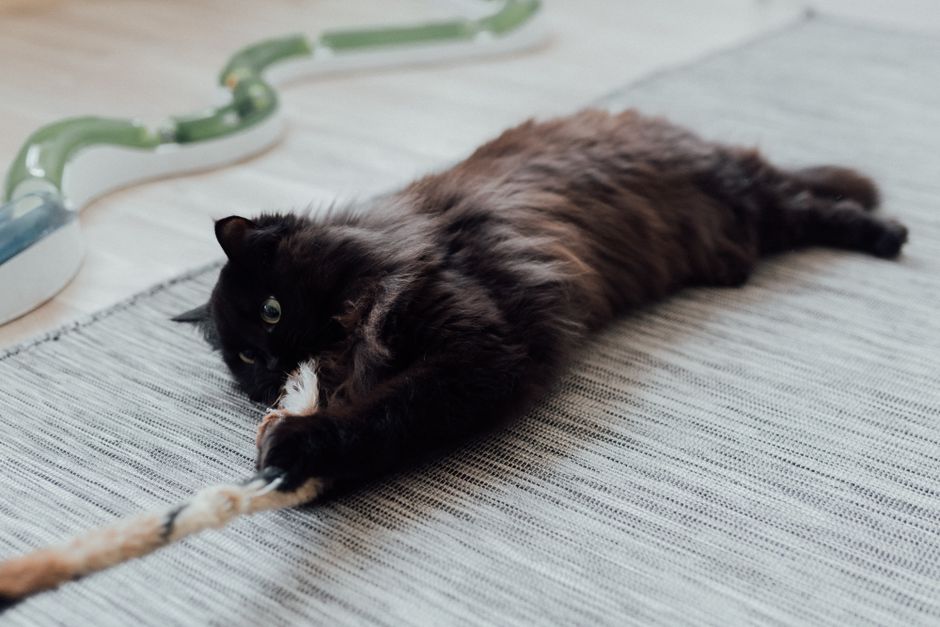
When I finally figured out how to use a wand toy correctly, Pepper transformed. That typically aloof cat who tolerated my existence suddenly wanted to interact with me—actively seeking play sessions, following me around waiting for the toy, and actually making eye contact. I realized I hadn't been using wand toys; I'd just been waving them randomly around hoping she'd engage.
After learning proper technique and understanding cat hunting behavior, wand toys became our primary bonding activity and her main source of exercise. It sounds dramatic, but good wand toy play fundamentally changed our relationship.
Why Wand Toys Work (The Predatory Drive Behind It)
Cats are hunters. Even well-fed indoor cats have hunting instincts hardwired into their DNA. Wand toys satisfy that drive in a controlled way—they're the only interactive toy that truly mimics prey behavior.
When you use a wand toy correctly, you're essentially triggering your cat's complete predatory sequence:
- Stalking (the stalk)
- Pouncing (the attack)
- Catching (the capture)
- Killing (the shake/thrash)
- Eating (this is where you let them "win" and hold the toy)
A wand toy activated properly provides all five elements, which is why cats find them infinitely more engaging than balls or mice toys left to their own devices.
You Might Also Enjoy
- Interactive Cat Toys That Actually Keep Felines Entertained
- Why Cats Need Toys: The Connection Between Play and Health
- The Best Chew Toys for Aggressive Chewers
- The Best Puzzle Toys for Dogs Who Get Bored Easily
The Basic Wand Toy Anatomy
Before technique, understand what you're working with:
The Wand: Usually a stick or rod, 24-36 inches long. Flexibility matters—slightly bendable is better than rigid.
The Attachment: String, cord, or elastic line connecting the toy to the wand. Length matters: 12-18 inches is ideal.
The Lure: What's on the end. Options include:
- Feathers (most realistic, highly engaging)
- Fabric strips (good for different movement patterns)
- Foam or silicone attachments (safer if swallowed, though not ideal)
- Crinkly toys (auditory stimulation)
- Bells (auditory trigger)
The Best Design: Feather attachments with elastic or string that's strong enough to withstand thrashing but flexible enough to move naturally. Popular brands include Godeep, Zzcat, and Cat Dancer.
Proper Wand Toy Technique: The Foundation
How NOT to Use a Wand Toy:
- Waving it slowly in circles (boring to cats, defeats the purpose)
- Moving it predictably (cats learn the pattern and lose interest)
- Holding it at your chest level (too high, unnatural)
- Making it do impossible things (jerking it violently, moving in ways real prey wouldn't)
How TO Use a Wand Toy:
The Basic Technique: Simulating Prey Movement
-
Hold the wand at waist level or slightly below, not up high. The toy should move roughly at your cat's eye level when they're in play position.
-
Move the lure along the ground initially, mimicking a mouse or bird landing and walking. Use short, deliberate movements—think "small animal scurrying," not "erratic chaos."
-
Vary speed: Fast darting movements draw attention; slower creeping movements encourage stalking. Mix them up in the same play session.
-
Use pauses and delays: Let the toy "rest" for a second or two before moving again. Real prey doesn't move continuously—it stops to look around, to listen. Use these pauses to let your cat stalk closer.
-
Direction changes are critical: Sudden direction changes trigger the pounce. A mouse running in a straight line isn't as engaging as one that suddenly changes direction. Practice quick pivots and unexpected movements.
-
Height variation: Move the toy from ground level to slightly elevated, mimicking a bird or flying insect. Most cats enjoy wand toys with feather attachments when elevated slightly, but keep them reachable—too high and the cat gives up.
The Advanced Technique: The Hunt Sequence
Once you understand basic movement, create complete "hunts":
Phase 1: The Approach (1-2 minutes)
- Move the toy slowly and predictably
- Let your cat stalk
- Make eye contact occasionally; let them see you're "prey"
- This builds tension
Phase 2: The Engagement (1-2 minutes)
- Increase speed
- Introduce direction changes
- Add pauses and sudden movements
- Encourage pouncing
Phase 3: The Capture (30-60 seconds)
- Let your cat catch the toy
- Don't jerk it away
- Let them hold and thrash it
- This is the "kill" and satisfaction moment
Phase 4: The Break (1-2 minutes)
- Stop playing
- Let the cat hold/chew the toy briefly
- Transition to rest (this mimics eating)
- Offer treats during this phase for positive association
Phase 5: The Reset (1-2 minutes)
- Start moving again
- Repeat until your cat loses interest
A full session is usually 10-20 minutes for active cats; 5-10 minutes for less engaged cats.
Reading Your Cat's Signals
Cats communicate whether they're engaged:
Signs of Engagement:
- Dilated pupils (predatory focus)
- Low body position (stalking posture)
- Tail low and twitching
- Ears forward, then back (alternating focus)
- Chattering or quiet vocalizations
- Immediate pounces
- Persistent interest (immediately returns for more)
Signs of Boredom/Disengagement:
- Walking away
- Sitting and watching without approaching
- Slow blinks (contentment, not engagement)
- Grooming instead of playing
- Repeated failure to pounce (toy is moving in an uninteresting way)
Signs of Overstimulation/Frustration:
- Sudden aggression toward your hand (not the toy)
- Hissing or swatting at you
- Wild, uncontrolled pouncing that loses focus
- Intense but chaotic play
If you see overstimulation, stop immediately. Most cats need breaks between sessions.
Common Mistakes People Make
Mistake 1: Letting the Toy Be Too Static Result: Cat loses interest instantly. Even "engaged" cats will walk away if the toy isn't mimicking real prey movement.
Mistake 2: Making It Impossible to Catch Result: Cat gets frustrated. Wand toys should be catchable; the goal isn't to keep it away forever. That's teasingly, not play.
Mistake 3: Playing Too Vigorously Result: Overstimulation, then aggression. What feels "exciting" to you may stress your cat. Moderate, controlled movement is better than wild flailing.
Mistake 4: Using the Same Wand Toy Every Day Result: Boredom. Rotate different wand toys. Different attachments feel different to cats and keep interest higher.
Mistake 5: Playing at the Wrong Time Result: Disengaged cat. Cats have activity cycles. Play when they're naturally active (dawn and dusk for most cats, but every cat is different). Reading your cat's natural energy helps.
Choosing the Right Wand Toy
For Most Cats: Feather attachments are most universally engaging. The movement, the texture, the (faint) realistic appeal—feather toys capture cats' attention better than most alternatives.
For Cats That Prefer String/Ribbon: Some cats prefer string or fabric strip attachments. These move differently and appeal to different predatory instincts.
For Cats That Prefer Height: Birds flying—use elevated movement with feather toys. These cats benefit from wand toys that allow elevated play.
For Cats That Prefer Ground Movement: Mice-type movement—keep the toy moving along the ground with quick direction changes and pauses.
Durability Consideration: If your cat is a thrash-and-destroy player, look for toys with reinforced attachment points. Cheap wand toys have the lure tear off after a few sessions. Spending $8-12 on a quality toy saves frustration.
Caution: Remove wand toys after play sessions. Unsupervised access means your cat might chew through the string and ingest it (potential blockage). Keep them stored safely.
Frequency and Duration
Optimal Schedule:
- 2-3 play sessions daily for active/younger cats
- 1-2 sessions daily for average cats
- 1 session daily or every other day for senior cats
Session Length:
- Young/active cats: 10-20 minutes
- Average cats: 5-15 minutes
- Senior cats: 5-10 minutes
Signs You're Doing Enough:
- Cat is relaxed between sessions
- No excessive crying for play
- Cat seems content after sessions
- No destructive behavior from boredom
The Bonding Element
What makes wand toy play uniquely bonding is that you're actively participating. You're not just providing a toy; you're engaging directly. This:
- Creates positive associations (your cat learns you're the source of excitement/fun)
- Increases eye contact and non-painful touch
- Builds communication (you learn to read your cat's signals)
- Requires trust (your cat has to let you near with the moving toy)
For cats that typically ignore their humans, wand toy play is often the breakthrough that changes the dynamic.
Pepper's Transformation
When I started using proper wand toy technique, Pepper went from tolerating my presence to actively seeking my attention. Within weeks, she was:
- Waiting by my feet when I came home, waiting for wand toy sessions
- Following me room to room in anticipation of playtime
- Making genuine eye contact
- Purring more frequently
- Sitting near me while I worked (didn't do this before)
The shift from "cat that exists in the same space as me" to "cat that actually interacts with me" happened because of 10-15 minutes of good wand toy play twice daily.
If your cat seems aloof or unengaged, don't assume they're just "not a people cat." They may just need the right form of interaction. For many cats, that's a well-used wand toy.
Resources